This stream archive runs about 76 minutes and opens on a card reading "Stream Archive" and "Chest Minecart Storage", with no episode number, so the number here comes from the playlist. None of it happens on the Hypermine server. "Today, we're not actually on the Hypermine server," Basket says, but the redstone is for it. The whole stream is in Basket's creative test world, at a pulled-apart copy of the small train station, and Basket is the only player on screen. The job is the last missing piece: somewhere to keep chest minecarts.
The last piece
Most carts can go in a dispenser, but a chest minecart is different. The station needs a store of them, a few columns stacked side by side, that knows how many carts each column holds, "so that I don't try and request one from one that doesn't have any." The holder Basket already has cycles carts down a column and pushes one out at the bottom. A cactus goes down at the end of the line so the spare carts break instead of piling up.
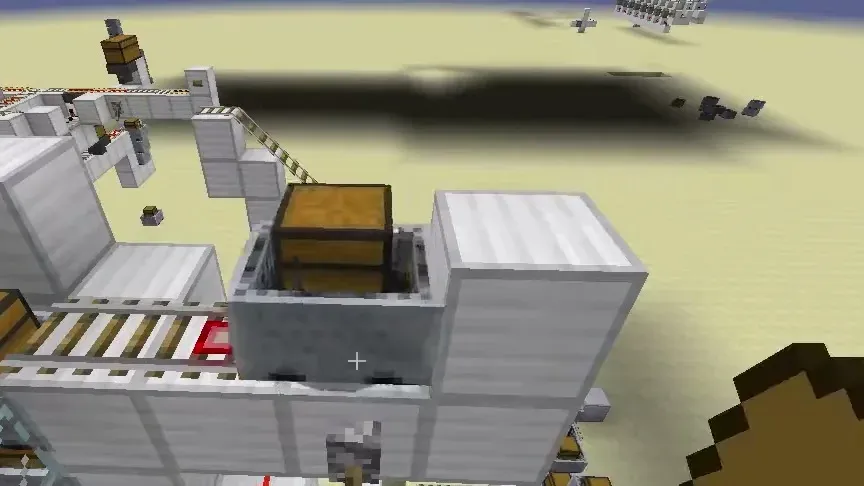
Basket wants to work it out without looking up anyone else's design, and the chat gets into it fast, with talk of stacks, queues and pop versus push.
Counting carts
The count is the hard part. The idea is that a dispenser fires an item down into a hopper every time a cart comes in, and one comes back out when a cart leaves, with a comparator reading how full the hopper is. It does not go smoothly. Items fly out where they shouldn't, a piece of granite turns up sitting in the open, and four carts in shows up as two. "For some reason I only counted half of them." For a while Basket is ready to give up on the idea: "We've made very little progress today."
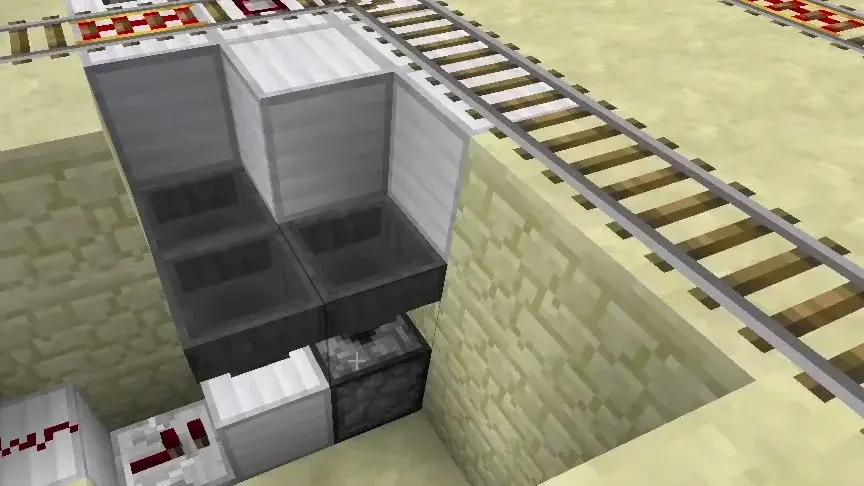
The chat keeps pitching ideas: a block around the top of the hopper, the dispensing direction, whether the detector turned off between carts. Then the dispensers come out and droppers go in. Carts go in one at a time, and the count climbs to ten, then eleven, and holds at eleven when one comes in as another goes out. "Yay! Okay, we made progress today. What would I do without the chat?"
Built to tile
Next, the columns have to link up. When a cart leaves the bottom of one column it rides a spiral of powered rail back up to the top of the next one. The last column skips the spiral and sends carts straight down the ramps to wherever they need to go. Powered blocks would bleed into the next copy, so the columns may need a one-block gap unless the power comes from redstone blocks.
Asking for a cart
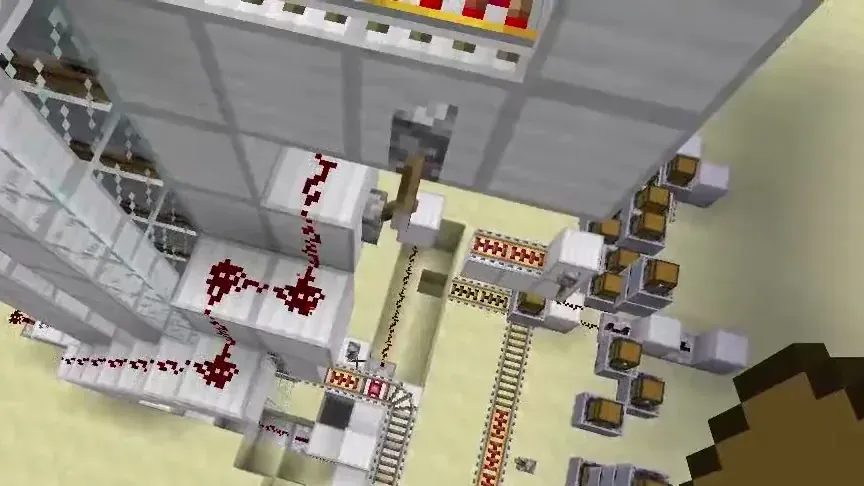
A request comes in as a signal along the bottom. If a column has carts, a sticky piston pushes a block across and the signal turns off into that column. If not, it runs on to the next one. Basket swaps the lever for a button "so that it's more realistic" and starts pressing. Carts roll out and the count drops: nine, seven, six, five, four. The numbers come out one short ("I'm off by one"), but when the column runs dry the signal moves on to a note block standing in for the next column, which gives a low thud.
Only two columns will fit in the space Basket has, at 11 carts each. Each train needs two carts, an engine and a caboose, and most of them should come back. As a backup, Basket plans a dispenser loaded from a chest of spare chest minecarts, to fire by hand when the store runs empty.
The rest of the plan
To finish, Basket flies around the test world to show how it fits together: the freight yard, where you can ask for eight chest minecarts, fill them and send them off, and the intersections. An early intersection reads a token, flips one of three tracks, and resets when the caboose goes through. A newer one has eight connection points where the tracks shift aside and back, and Basket plans to use it because it takes less room. Leftover tokens will ride a water channel back up and hitch a ride to the next station in passing chest carts.
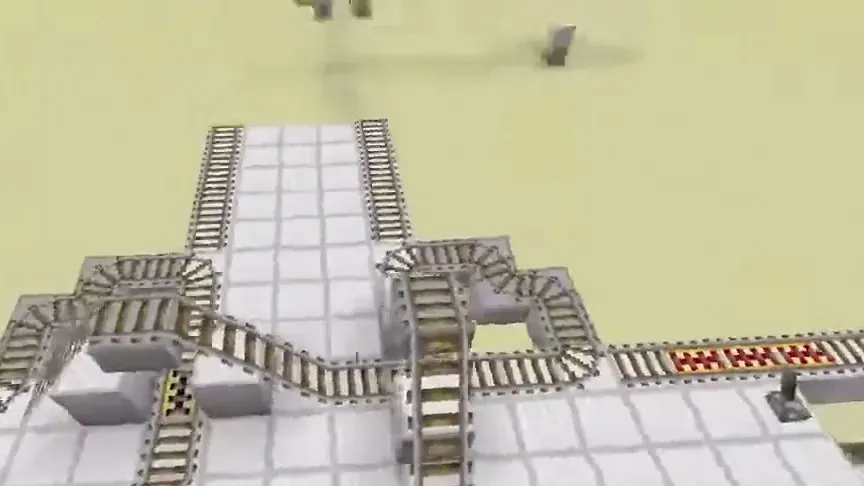
Basket started working all this out in creative about a month before the new server opened. Back in town, the small rail station is "mainly done," and this storage is the last thing it needs before it runs. The credits roll to the end of the video with no gameplay after them.