Episode 3 opens on the segment map with Sequence Counter, the segment named in the title, and the commentary says the aim is to beat a friend's scores. Basket passes Sequence Counter with fewer nodes and instructions than that friend, then moves straight on to Signal Edge Detector and passes it too before the video ends.
Sums and lengths
Sequence Counter's panel reads: "Sequences are zero-terminated. Read a sequence from IN. Write the sum to OUT.S. Write the length to OUT.L." The friend's line on the segment map shows 317 cycles, 6 nodes and 28 instructions. Planning the first node goes slowly: "this is more complicated than I thought because I only have one storage spot."
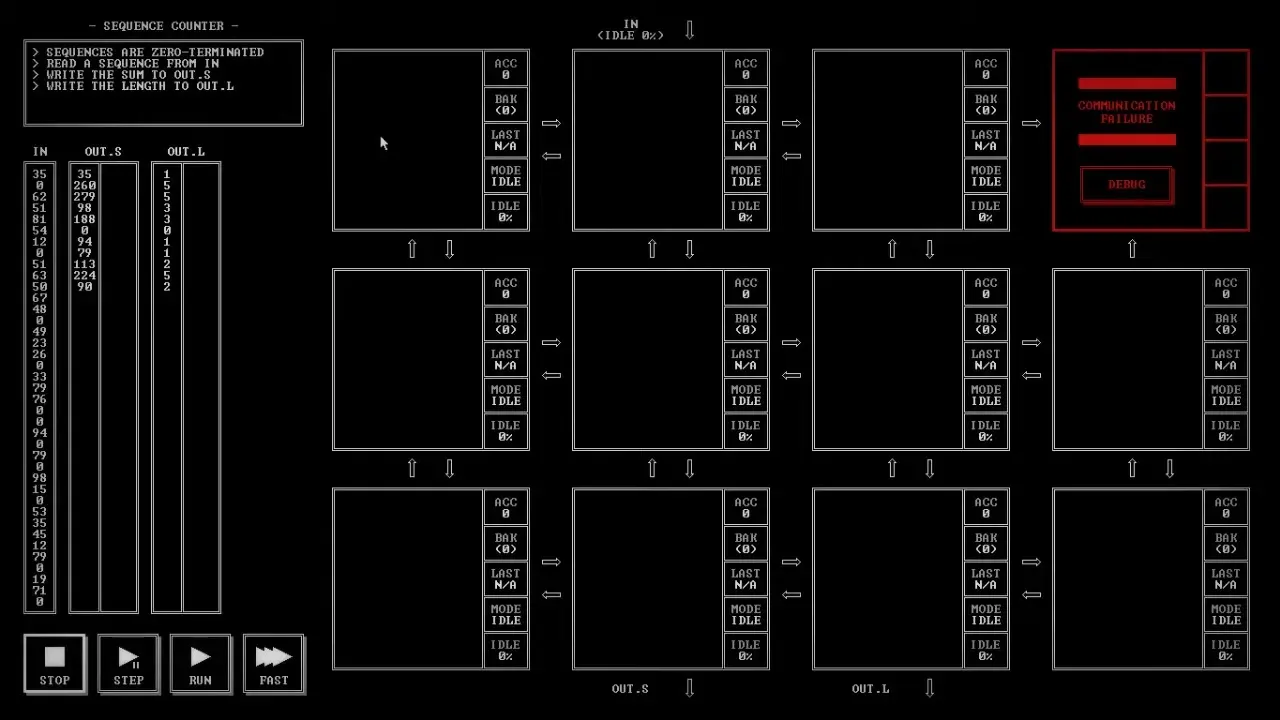
Saving and swapping
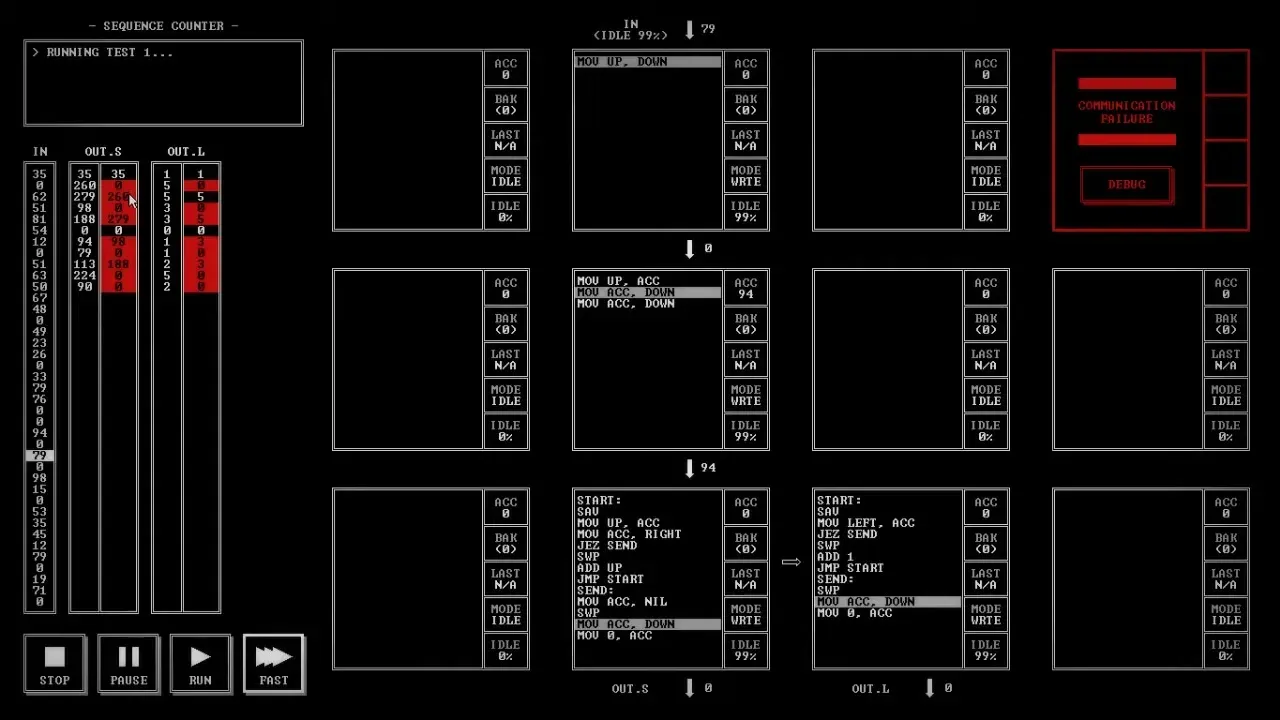
The answer on screen is SAV and SWP. The OUT.L node saves the count, reads a value with "MOV LEFT, ACC", jumps to a SEND label on zero with "JEZ SEND", and otherwise swaps the count back, runs "ADD 1" and loops. The OUT.S node does the same with a running sum. Under IN, a middle node sends each value down twice, so the sum node can pass one copy right to the count node and add the other.
One line eats a value
The first run marks rows of both OUT.S and OUT.L in red. "My sum ended up being zero." The commentary finds the line: under SEND, "MOV ACC, NIL" should throw away the second copy coming from above. It becomes "MOV UP, NIL," and every test passes in 336 cycles with 4 nodes and 24 instructions, against the friend's 317, 6 and 28. "I feel accomplished."
Changes of 10 or more
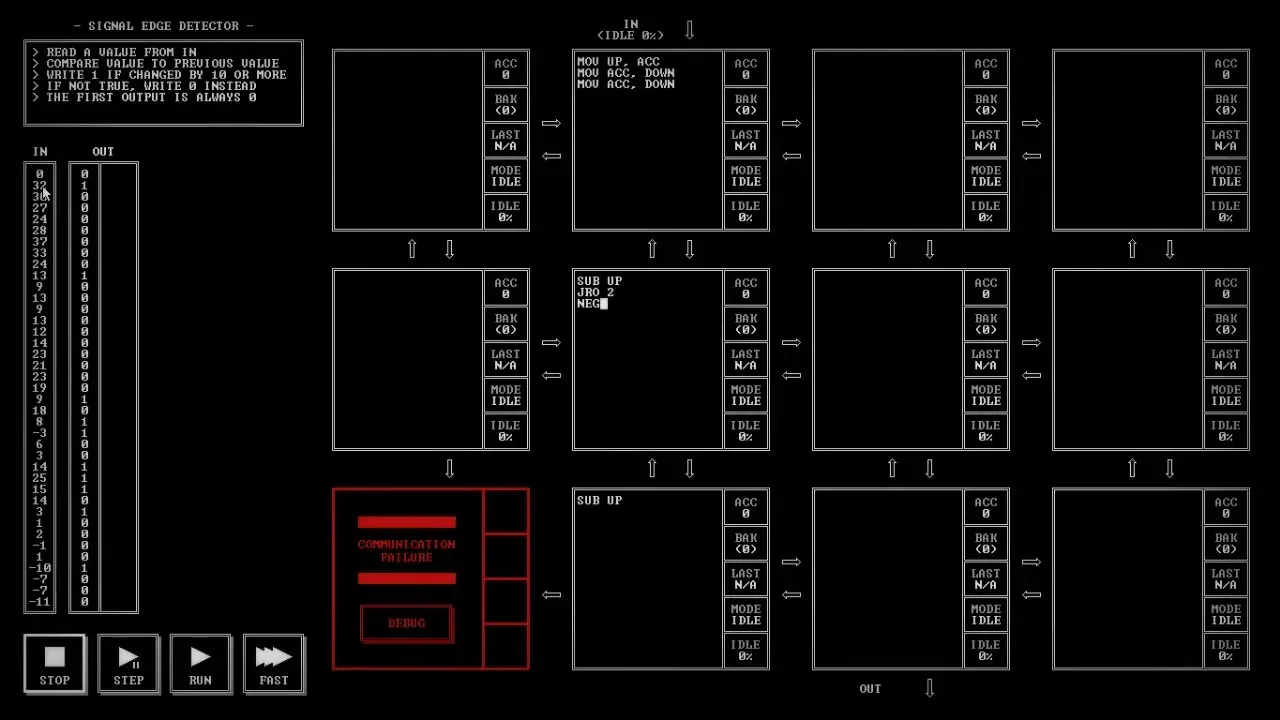
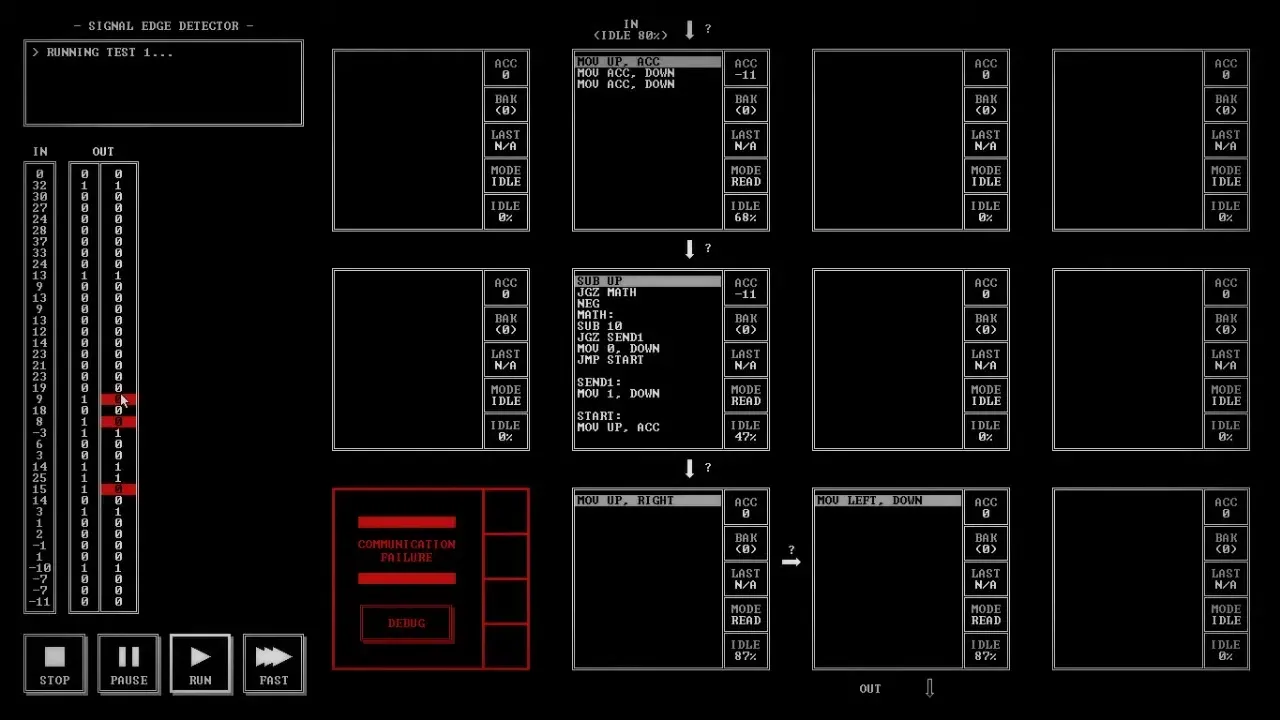
Signal Edge Detector says: "Read a value from IN. Compare value to previous value. Write 1 if changed by 10 or more. If not true, write 0 instead. The first output is always 0." The friend's line shows 4 nodes and 17 instructions. The node under IN again sends each value down twice, and the next node starts with "SUB UP." The commentary wants an absolute value and tries "JRO 2" to skip a line, then replaces it with "JGZ MATH" and a "NEG" for negative changes, followed by "SUB 10."
Exactly 10
The first full run shows a few red rows in OUT. "It fails if it is exactly equal." The test changes from "JGZ SEND1" to "JLZ SEND0," with the 1 and 0 lines swapped to match. The next run passes in 385 cycles with 4 nodes and 14 instructions, three instructions fewer than the friend. "I'm a winner."
Where it ends
The Signal Edge Detector result screen stays up while the commentary closes the episode, and the video cuts to the end card with both segments passed.