This one is all redstone. Basket spends the episode under the library, building a machine that lifts a section of the bookshelf wall into the ceiling and drops it back down. It takes a lot of failed tests to get there.
A table that won't move
The first test happens on camera: a sticky piston against the enchanting table. "You can't pull these guys with a sticky piston." Basket had hoped for a block swapper that would pull the table down and put a stone brick in its place, but "you can't move obsidian with sticky pistons." That was only a side idea. The main plan is still on.
The plan
After "the last two or three hours" of testing, Basket lays it out. Four pistons push gravel up under the bookshelves, and the gravel pushes the wall up. Then the pistons drop away, the gravel falls back into the floor, and the opening is exposed. Another set of pistons in the ceiling closes it again. The idea came from another YouTuber's castle portcullis, which used three pistons. Basket looked up that design, "didn't quite like the way it worked," and set out to build a different one.
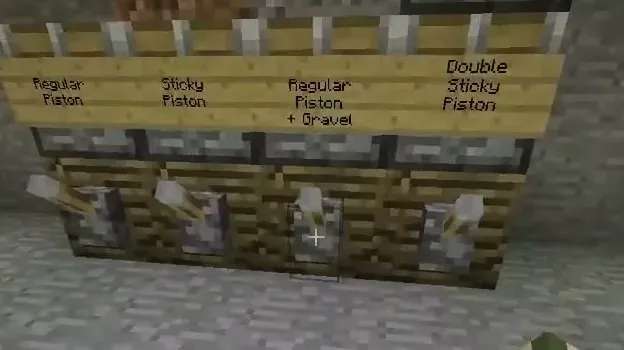
For anyone newer to Minecraft, a test bench with signs covers the basics. A regular piston pushes but doesn't pull back. A sticky piston retracts. Gravel on a piston falls back once the piston drops. And a sticky piston can't pull down another sticky piston while the top one is still powered: "It has to be unpowered first."
Counting pistons
A model of the stack, laid on its side with a numbered lever under each piston, shows why four is harder than three. Three pistons go up with "one, three, five." Four go up with "1, 3, 5, and 7," but coming down is "seven, five, three, and then power four, unpower four," and more steps after that. "So you need to program all that in Redstone."
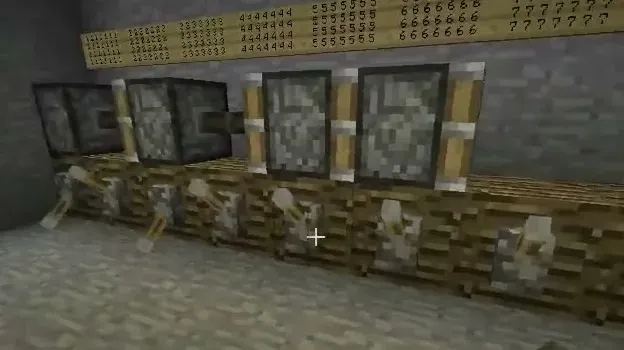
The real stack is three sticky pistons with a regular one on top, since "there's no reason to stick it to the actual gravel." The odd-numbered pistons are wired from one side and the even ones from the other. A button stays on for longer than Basket wants, so a converter cuts it down to a two-tick pulse, and a T flip-flop lets one press run the whole sequence.
"It's a mess"
The first full test, from an observation spot up top: "Sort of." The bottom piston doesn't turn off. After more work off camera: "And there we have it." Along the way, torches clashed with the layers below them, a torch-based signal elevator kept "messing up with my signals," and the plan for powering the third piston had to change. "It's a mess. I might clean it up at some point."
Gravel and the top row
The ceiling pistons go in next, and one button alternates between them and the stack below. The first try leaves one spot unpushed. "Oh, because I don't have any pistons there." Part of it was built one block too far over, so Basket moves it on camera. Then the gravel keeps breaking, the closing push falls short, a row of pistons turns out to be missing, and the whole top section gets moved down. "How many times can I say the word 'push'?" Basket wires up a lever to test the top pistons by hand.
The wall opens
A small delay "for some reason seems to help" the gravel, and the top layer gets reworked again. "I think it's actually working now." The wall goes up. "Yay!"
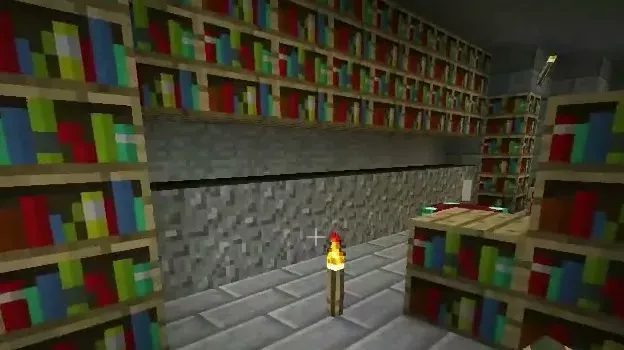
Basket adds one more repeater and runs it again, fingers crossed. "Wow, that took a really long time to do this whole project." One more press, and the bookshelves come back down. "Awesome."
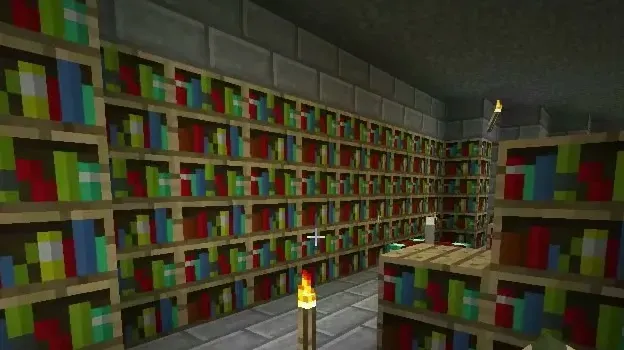
The space behind is still empty stone. Basket plans to fill it with "chests and other stuff regarding enchanting." The episode ends with Basket alive in the library and the wall working.